1. Numbers and Operations
A. Decomposing Numbers
http://kindercraze.blogspot.com/2012/03/getting-interactive-with-common-core.html
In this activity students find different ways to make a number, for instance - 9 ways to make 8.
They use construction paper squares in different colors to visually represent addition
problems. This could be applied to subtraction, multiplication, and division.

B. Domino Parking Lot
http://www.abcand123learning.com/2010/09/play-to-learn-numbers-counting.html
While this site has a lot of different math games, the main one I wanted to include was the
Domino Parking Lot activity. This is a great activity that can be used in the lower grades and
the higher grades with just a few adaptations.
Younger kids can count the dots and place the domino in the corresponding "parking lot." For
older classes, students can add the dots, subtract the dots, or even multiply them.

C. Teaching Fractions with Pattern Blocks
http://teacherblogspot.com/?cat=946
Teaching fractions with pattern blocks is a great idea! It is an idea that benefits both visual and
kinesthetic learners as they see the fractions in a whole new way and they work hands on with
the numbers.
It is also great because you can integrate geometry and numeric aspects of a lesson as students
visually represent fractions through the use of pattern blocks.

D. My Name in Fractions
http://teachinginhighheels.blogspot.com/search/label/free%20printables
My Name in Fractions is a great activity for students who are learning fractions. They can
identify the number of letters in their name for the denominator. They can then use a number
of characteristics for the numerator. They can count the number of consonants, vowels, a
certain letter, etc.

E. Memory Game
http://www.classroomfreebies.com/2011/12/fractions-freebie.html
This memory game has students match a fraction with a different representation of the number
(number line, dots, picture, etc). It challenges students to show that they know what a fraction
represents and that they can display it in different ways.

F. Cool Fraction Activities
http://www.mathwire.com/fractions/fracactivities.html
This is a great activity for students. They each receive a card with a fraction on it and then
they have to line up in order from smallest to largest. This not only gets them thinking about
fractions, but it gets them up and moving.

G. Fact Families
http://www.alyciazimmerman.com/math-charts.html
Fact families are a great way for students to review the operations they have learned. This is
a great way to explain the fact families as it labels the sum and the numbers that are to be
added.

H. Subtraction Spinners
http://www.teacherspayteachers.com/Product/2-digit-subtraction-game-without-regrouping
This would be a great math center in which students could practice their subtraction facts by
spinning two spinners and subtracting the smaller number from the larger number.

I. UNO
http://eisforexplore.blogspot.com/search/label/uno
This site has a number of great games to review operations using UNO cards.

J. Multiplication Concentration
http://kidsactivitiesblog.com/7298/halloween-math-games
This is a classic memory game with a little twist - match multiplication facts with the proper
product displayed on the bottoms of Hershey's Kisses. Kids will love the chance of getting to
work with candy.

K. Equivalent Fractions Video
http://pinterest.com/pin/110267890848424549/
Here is a great video to show when talking about equivalent fractions.
2. Algebra
A. Decomposing Numbers
http://kindercraze.blogspot.com/2012/03/getting-interactive-with-common-core.html
Students can add the proper number of squares of a different color to get the answer, rather
than simply adding the different colored squares together.
B. Hidden Peeps
http://happyteacherhappykids.com/spring-peeps-madness/
This is a great Easter time algebraic activity for addition (although it can be applied to other
operations). One number in the equation is replaced by a peeps image so the student only has
one number and the product.

C. Math Games with a Deck of Cards
http://imaginationsoup.net/2009/06/deck-of-cards-for-math-fun/
This is a brief view of a few card games that you can use to practice operations. There are
ideas for younger and older kids.

D. 45 Math Games using Dice
http://kbkonnected.tumblr.com/post/12928926198/40-resources-for-dice-and-everything-dice
This is a great list of games that you can play in the classroom to review operations using dice.

3. Geometry
A. Easter Geometric Bunny
http://www.teacherspayteachers.com/Product/Easter-Bunny-Geometric-Shape-Rabbit
Great geometric visual review of squares, triangles, circles, and rectangles that allows students
to work on fine motor skills as well.

B. A Great Idea for Teaching Lines
http://millsteach105.blogspot.com/2013/01/classroom-freebies-geometry-lines-rays.html
This is a simple but concrete hands on method for teaching/reviewing lines, rays, angles, and
line segments, among other things.

C. A Fun Twist on Sight Word Bingo
http://thefirstgradesweetlife.blogspot.com/2011/02/reading-centers.html
This is a great activity for reviewing sight words and geometry. It allows students to consider
spacing, but students can also be asked to name the shape when they cover up a sight word.

D. Solid Shapes Smartboard
http://www.teacherspayteachers.com/Product/Solid-Shapes-3d-Math-SmartBoard-Lesson-Primary-Grades
Smartboard activity for reviewing solid shapes.

4. Measurement
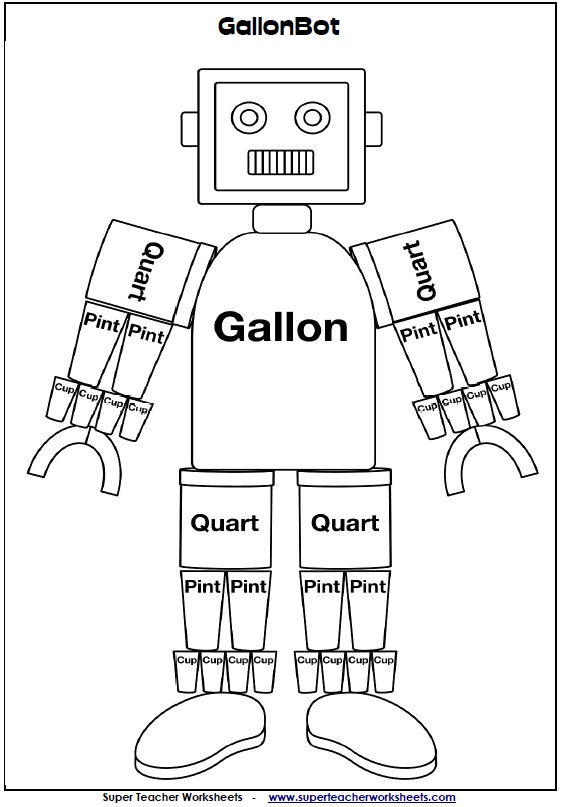
A. Gallon Bot
http://www.superteacherworksheets.com/images/gallon-bot.jpg
This is a visual that can help students remember conversions between gallons, quarts, pints, and
cups.

B. I Wish Someone Would Have Bought This
http://pinterest.com/pin/110267890848821982/
Another great visual reminder for conversions between Gallons, Quarts, Pints, and Cups.

C. Measure the Length Game
http://www.teachersnotebook.com/product/MrsLane/measure-the-length-game-great-whole-class-activity
Students estimate the length of objects around the room, then they measure them to see how
close their predictions were.

5. Data Analysis and Probability
A. Shake and Spill
http://pinterest.com/pin/92605336060086520/
Students can do this in small groups moving from station to station. They shake a cup of red
and yellow beads, spill them out, and record how many beads there were of each color. Then
they add the two numbers to get the total number of beads. This is done at a number of stations
which each have a different number of beads in the cups.

B. Free Throws
http://pinterest.com/pin/141159769543008049/
This is a great activity that allows students to analyze data and calculate probability while also
allowing them to get in some physical activity. Students shoot free throws and then they can
analyze their performance and calculate the probability that they will make a future shot.

C. Charting Favorites
http://pinterest.com/pin/69313281737748838/
Students can chart anything really - maybe their favorite color, number, book, school subject,
food, etc. Then they can analyze their results (how many people out of the total like pizza, how
many people didn't like the color blue, etc).

D. M & M Data Analysis and Probability
http://pinterest.com/pin/36380709461265018/
Students put data in tables, picture graphs, bar graphs, and line charts. They can also calculate
probabilities.

E. Probability Games
http://www.wartgames.com/themes/math/probability.html
Use these games and activities when reviewing probability.

6. Problem Solving
A. Fraction Number line
http://www.mathwire.com/fractions/fracactivities.html
http://pinterest.com/pin/110267890848675977/
Here are two different ways to use fraction number lines. They require students to use problem
solving skills as they figure out how to arrange the numbers properly across the number line.
B. CUBE
http://pinterest.com/pin/224757837623006298/
Students will need to be able to problem solve when taking those mandatory tests. This is a great
reminder about how to solve problems.

C. Monster Problem Solving
http://www.teachersnotebook.com/product/CreativeClassroom/free-monster-math-problem-solving
Problem solving activities for pre-k through fifth grade.

D. Number Tiles
http://www.teacherspayteachers.com/Product/Number-Tiles-FREE-Problem-Solving-Activities-for-the-Primary-Grades
Six free problem solving activities using number tiles.

7. Reasoning/Proof
A. Algebraic Reasoning
http://pinterest.com/pin/211458144975899661/
Video about function boxes and algebraic reasoning.
B. Creating Shapes
http://pinterest.com/pin/138907969728687771/
Students will be asked to make simple geometric shapes using combinations of other shapes.

C. Card Pick Up
http://www.education.com/activity/article/card-pick-up/
This card game makes students use their reasoning skills to decide whether to pick up one or
two cards each turn.

D. Calculator Puzzles
http://www.teacherspayteachers.com/Product/Calculator-Puzzles
In this activity, students must use all of the numbers highlighted on a calculator to get a
specified answer. It makes them use reasoning to figure out how to combine the numbers to get
their answer.

8. Communication
A. Math as a Social Activity
http://www.edutopia.org/math-social-activity-cooperative-learning-video
This is a guide to practicing math as a social activity.

9. Connections
A. Coin Song
http://todayinfirstgrade.blogspot.com/2012/03/just-bit-of-money.html
Kids are fascinated by money and need to learn about it in order to use it. This song teaches
them the basics.

B. Lots of Money Activities
http://the-learningtree.blogspot.com/2012/10/money-money-money-loads-of-freebies.html
Here are some more activities to teach about money that students will need to know about.

C. Teaching Through Real Life
http://52brandnew.com/2012/10/23/teaching-math-through-real-life-experience/
Here is a list of activities based on real life for students. It is important for them to see how they
will apply what they learn in school in real life.

D. Time Teller
http://eisforexplore.blogspot.com/2012/05/time-teller-cheat-and-peek.html
This is a great clock that can benefit visual and kinesthetic learners read analog clocks. This is a
skill that many students need to practice.

10. Representation
A. Wanted!
http://mathcoachscorner.blogspot.ca/2012/04/wanted.html
Poster having students display several ways to represent one number.

B. Place Value
http://www.parents.com/blogs/homeschool-den/2010/01/19/math/first-grade-math-additionplace-value/
Students represent place value in terms of the whole number and the number of 1000's, 100's,
10's, and 1's.

C. Math Representation
http://mathcoachscorner.blogspot.ca/2012/04/more-connections.html
This activity has kids look at money in written form and in picture form as they work on
adding and counting by 5.

D. Easter Egg Number Representation
http://room-mom101.blogspot.com/2010/03/easter-egg-matching-activity.html
Use plastic Easter Eggs to review different representations of numbers. This activity can also
be used to represent addition, subtraction, or multiplication problems.


Hey! Great post I just came across
ReplyDeleteyour blog and I love it!
I really enjoyed to read that all i will always follow You thanks for the great article.
Regards
FASTSEEDBOX
Best Neck Knife of 2025 on Amazon | Top Compact Picks
ReplyDeleteWelcome to the ultimate guide on the Best Neck Knife !We’ve got you covered whether you need a compact self-defense tool, a reliable outdoor companion, or a discreet everyday carry option. In this video, we’ll break down the top neck knives, highlighting their unique features, blade materials, ergonomics, and carry options. By the end, you’ll know exactly which knife fits your needs. Don’t forget to like, subscribe, and hit the notification bell for more gear reviews. Now, let’s dive into the best neck knives you can get today !.....see more