Nebraska
Mathematics Standards
Grade 1
MA 1.1 Students will
communicate number sense concepts using multiple representations to reason,
solve problems, and make connections within mathematics and across disciplines.
MA 1.1.1 Number
System: Students will demonstrate, represent, and show relationships among
whole numbers within the base-ten number system
MA 1.1.1.a Count, read, and write numbers 0 –
100
MA 1.1.1.b Count by multiples of 2 up to 50
MA 1.1.1.c Count by multiples of 5 up to 100
MA 1.1.1.d Count by multiples of 10 up to 100
MA 1.1.1.e Sequence objects using ordinal
numbers (first through tenth)
MA 1.1.1.f Count backwards from 10 – 0
MA 1.1.1.g Connect number words to the quantities
they represent 0 – 20
MA 1.1.1.h Demonstrate and identify multiple
equivalent representations for numbers 1 – 100 (e.g., 23 is 2 tens and 3 ones;
23 is 1 ten and 13 ones; 23 is 23 ones)
A. Decomposing Numbers
B. Wanted!
MA 1.1.1.i Compare and order whole numbers 0
– 100
A. UNO
http://eisforexplore.blogspot.com/search/label/uno
A. UNO
http://eisforexplore.blogspot.com/search/label/uno
MA 1.1.1.j Demonstrate relative position of
whole numbers 0 – 100 (e.g., 52 is between 50 and 60; 83 is greater than 77)
A. UNO
http://eisforexplore.blogspot.com/search/label/uno
http://eisforexplore.blogspot.com/search/label/uno
MA 1.1.2 Operations: Students will demonstrate the meaning
of addition and subtraction with whole numbers.
MA 1.1.2.a
Use objects, drawings, words, and symbols to explain addition as a joining
action
A. Decomposing Numbershttp://kindercraze.blogspot.com/2012/03/getting-interactive-with-common-core.html
B. Domino Parking Lot
http://www.abcand123learning.com/2010/09/play-to-learn-numbers-counting.html
http://kbkonnected.tumblr.com/post/12928926198/40-resources-for-dice-and-everything- dice
MA 1.1.2.b
Use objects, drawings, words, and symbols to explain addition as parts of a
whole
A. Decomposing Numbershttp://kindercraze.blogspot.com/2012/03/getting-interactive-with-common-core.html
MA 1.1.2.c
Use objects, drawings, words, and symbols to explain subtraction as a
separation action
MA 1.1.2.d
Use drawings, words, and symbols to explain subtraction as finding part of a
whole
MA 1.1.2.e
Use objects, drawings, words, and symbols to explain subtraction as a
comparison (e.g., Nancy has 8 hair ribbons. Jane has 5 hair ribbons. How many
more hair ribbons does Nancy have than Jane)
MA 1.1.3 Computation:
Students will compute fluently and accurately using appropriate strategies and
tools.
MA 1.1.3.a Fluently add whole number sums up
to 10
A. Fact Families
http://www.alyciazimmerman.com/math-charts.html
A. Fact Families
http://www.alyciazimmerman.com/math-charts.html
MA 1.1.3.b Fluently subtract whole number
differences from 10
A. Fact Familieshttp://www.alyciazimmerman.com/math-charts.html
MA 1.1.3.c Add and subtract two-digit numbers
without regrouping
A. Fact Familieshttp://www.alyciazimmerman.com/math-charts.html
MA 1.1.3.d Use a variety of methods and tools
to compute sums and differences (e.g., models, mental computation,
paper-pencil)
A. Calculator Puzzleshttp://www.teacherspayteachers.com/Product/Calculator-Puzzles
MA 1.1.4 Estimation: Mastery
not expected at this level.
 MA 1.2
Students will communicate geometric concepts and measurement concepts using
multiple representations to reason, solve problems, and make connections within
mathematics and across disciplines.
MA 1.2
Students will communicate geometric concepts and measurement concepts using
multiple representations to reason, solve problems, and make connections within
mathematics and across disciplines.
MA 1.2.1 Characteristics:
Students will identify characteristics of two-dimensional geometric shapes.
MA 1.2.1.a Compare two-dimensional shapes
(e.g., square, circle, rectangle, triangle)
A. Easter Geometric Bunnyhttp://www.teacherspayteachers.com/Product/Easter-Bunny-Geometric-Shape-Rabbit
MA 1.2.1.b Describe attributes of
two-dimensional shapes (e.g., square, circle, rectangle, triangle)
A. Easter Geometric Bunny
http://www.teacherspayteachers.com/Product/Easter-Bunny-Geometric-Shape-Rabbit
A. Easter Geometric Bunny
http://www.teacherspayteachers.com/Product/Easter-Bunny-Geometric-Shape-Rabbit
MA 1.2.2 Coordinate
Geometry: Students will identify locations on a number line.
MA 1.2.2.a Identify the position of a whole
number on a horizontal number line
MA 1.2.3 Transformations:
Students will identify a line of symmetry
MA 1.2.3.a Identify one line of symmetry in
two-dimensional shapes (e.g., circle, square, rectangle, triangle)
MA 1.2.4 Spatial
Modeling: Students will communicate relative positions in space and create two-dimensional
shapes.
MA
1.2.4.a Demonstrate positional words (e.g., left/right)
MA
1.2.4.b Sketch two-dimensional shapes (e.g., square, circle, rectangle,
triangle)
A. Solid Shapes Smartboard
http://www.teacherspayteachers.com/Product/Solid-Shapes-3d-Math-SmartBoard-Lesson-Primary-Grades
MA 1.2.5 Measurement:
Students will measure using standard units, time, and money.
MA 1.2.5.a Count like coins to $1.00
A. Lots of Money Activities
http://the-learningtree.blogspot.com/2012/10/money-money-money-loads-of-freebies.html
http://the-learningtree.blogspot.com/2012/10/money-money-money-loads-of-freebies.html
B. Teaching Through Real Life
C. Math Representation
http://mathcoachscorner.blogspot.ca/2012/04/more-connections.html
MA 1.2.5.b Identify time to the half hour
A. Time Tellerhttp://eisforexplore.blogspot.com/2012/05/time-teller-cheat-and-peek.html
MA 1.2.5.c Identify past, present, and future
as orientation in time
MA 1.2.5.d Select an appropriate tool for the
attribute being measured (e.g., clock, calendar, thermometer, scale, ruler)
MA 1.2.5.e Measure length using inches
MA 1.2.5.f Compare and order objects
according to length
MA 1.3 Students will
communicate algebraic concepts using multiple representations to reason, solve
problems, and make connections within mathematics and across disciplines.
A. Hidden Peeps
http://happyteacherhappykids.com/spring-peeps-madness/
B. Algebraic Reasoning
http://pinterest.com/pin/211458144975899661/
MA 1.3.1 Relationships:
Students will identify and describe relationships.
MA 1.3.1.a Sort or order objects by their
attributes (e.g., color, shape, size, number) then identify the classifying
attribute
MA 1.3.1.b Create multiple rules for sorting
beyond color, shape, and size
MA 1.3.1.c Identify, describe, and extend
patterns (e.g., patterns with a repeating core)
MA 1.3.1.d Use <, =, > to compare quantities
A. UNO
http://eisforexplore.blogspot.com/search/label/uno
MA 1.3.2 Modeling in
Context: Students will use objects and pictures as models to represent
mathematical situations.
MA 1.3.2.a Model situations that involve the
addition and subtraction of whole numbers 0 – 20, using objects and pictures
A. Domino Parking Lot
http://www.abcand123learning.com/2010/09/play-to-learn-numbers-counting.html
MA 1.3.2.b Describe and model quantitative change
(e.g., a student growing taller)
MA 1.3.3 Procedures: Students
will use concrete, verbal, and visual representations to solve number
sentences.
MA 1.3.3.a Write
number sentences to represent fact families
A. Fact Familieshttp://www.alyciazimmerman.com/math-charts.html
MA 1.3.3.b Use
concrete, pictorial, and verbal representations of the commutative property of
addition
MA 1.4 Students will
communicate data analysis/probability concepts using multiple representations
to reason, solve problems, and make connections within mathematics and across
disciplines.
A. Shake and Spill
http://pinterest.com/pin/92605336060086520/
B. Free Throws
http://pinterest.com/pin/141159769543008049/
C. Charting Favorites
http://pinterest.com/pin/69313281737748838/
D. M & M Data Analysis and Probability
http://pinterest.com/pin/36380709461265018/
E. Probability Games
http://www.wartgames.com/themes/math/probability.html
A. Shake and Spill
http://pinterest.com/pin/92605336060086520/
B. Free Throws
http://pinterest.com/pin/141159769543008049/
C. Charting Favorites
http://pinterest.com/pin/69313281737748838/
D. M & M Data Analysis and Probability
http://pinterest.com/pin/36380709461265018/
E. Probability Games
http://www.wartgames.com/themes/math/probability.html
MA 1.4.1 Display and
Analysis: Students will sort, classify, organize, describe, and compare data.
MA 1.4.1.a Sort and classify objects by more
than one attribute
MA 1.4.1.b Organize data by using concrete
objects
MA 1.4.1.c Represent data by using tally
marks
MA 1.4.1.d Compare and interpret information
from displayed data (e.g., more, less, fewer)
MA 1.4.2 Predictions
and Inferences: Mastery not expected at this level.
MA 1.4.3 Probability:
Mastery not expected at this level.
Nebraska
Mathematics Standards
Grade 2
MA 2.1 Students will
communicate number sense concepts using multiple representations to reason,
solve problems, and make connections within mathematics and across disciplines.
A. Fraction Number linehttp://www.mathwire.com/fractions/fracactivities.html
http://pinterest.com/pin/110267890848675977/
B. CUBE
http://pinterest.com/pin/224757837623006298/
C. Monster Problem Solving
http://www.teachersnotebook.com/product/CreativeClassroom/free-monster-math-problem-solving
D. Number Tiles
http://www.teacherspayteachers.com/Product/Number-Tiles-FREE-Problem-Solving-Activities-for-the-Primary-Grades
E. Algebraic Reasoning
http://pinterest.com/pin/211458144975899661/
F. Creating Shapes
http://pinterest.com/pin/138907969728687771/
G. Card Pick Up
http://www.education.com/activity/article/card-pick-up/
H. Calculator Puzzles
http://www.teacherspayteachers.com/Product/Calculator-Puzzles
MA 2.1.1 Number
System: Students will demonstrate, represent, and show relationships among
whole numbers within the base-ten number system.
MA 2.1.1.a
Read and write numbers 0 – 1,000 (e.g., count numbers from 400 – 500; write
numbers from
400 – 500)
MA 2.1.1.b Count by multiples of 2 up to 100
MA 2.1.1.c Count backwards from 20 – 0
MA 2.1.1.d Connect number words to the quantities
they represent 0 – 100
MA 2.1.1.e Demonstrate multiple equivalent
representations for numbers 1 – 1,000 (e.g., 423 is 4 hundreds, 2 tens and 3
ones; 423 is 3 hundreds 12 tens and 3 ones)
A. Place Valuehttp://www.parents.com/blogs/homeschool-den/2010/01/19/math/first-grade-math-additionplace-value/
MA 2.1.1.f Compare and
order whole numbers 0 – 1,00
MA 2.1.1.g Demonstrate relative position of
whole numbers 0 – 1,000 (e.g., 624 is between 600 and 700; 593 is greater than
539)
MA 2.1.1.h Use visual models to represent
fractions of one-half as a part of a whole
MA 2.1.2 Operations: Students will demonstrate the meaning
of addition and subtraction with whole numbers.
MA 2.1.2.a
Use objects, drawings, words, and symbols to explain the relationship between
addition and subtraction (e.g., if 2 + 3 = 5 then 5 – 3 = 2)
A. Fact Familieshttp://www.alyciazimmerman.com/math-charts.html
MA 2.1.2.b
Use objects, drawings, words, and symbols to explain the use of subtraction to
find a missing addend (e.g., if 3 + __ = 7, then 7- 3 = __.)
MA 2.1.3 Computation:
Students will compute fluently and accurately using appropriate strategies and
tools.
MA 2.1.3.a Fluently add whole number facts
with sums to 20
MA 2.1.3.b Fluently subtract whole number
facts with differences from 20
MA 2.1.3.c Add and subtract three-digit whole
numbers with regrouping
MA 2.1.3.d Use a variety of methods and tools
to compute sums and differences (e.g., models, mental computation,
paper–pencil)
MA 2.1.4 Estimation: Students
will estimate and check reasonableness of answers using appropriate strategies
and tools.
MA 2.1.4.a Estimate the results of two-digit
whole number sums and differences and check the reasonableness of such results
MA 2.1.4 b Estimate the number of objects in
a group
MA 2.2 Students will
communicate geometric concepts and measurement concepts using multiple
representations to reason, solve problems, and make connections within
mathematics and across disciplines.
http://www.teacherspayteachers.com/Product/Easter-Bunny-Geometric-Shape-Rabbit
B. A Great Idea for Teaching Lines
http://millsteach105.blogspot.com/2013/01/classroom-freebies-geometry-lines-rays.html
C. A Fun Twist on Sight Word Bingo
http://thefirstgradesweetlife.blogspot.com/2011/02/reading-centers.html
D. Solid Shapes Smartboard
http://www.teacherspayteachers.com/Product/Solid-Shapes-3d-Math-SmartBoard-Lesson-Primary-Grades
MA 2.2.1 Characteristics:
Students will describe characteristics of two-dimensional shapes and identify
three-dimensional objects.
MA 2.2.1.a Describe attributes of
two-dimensional shapes (e.g., trapezoid, parallelogram)
MA 2.2.1.b Determine if two shapes are
congruent
MA 2.2.1.c Compare two-dimensional shapes
(e.g., trapezoid, parallelogram)
MA 2.2.1.d Identify solid shapes (e.g.,
triangular prism, rectangular prisms, cones, cylinders, pyramids, spheres)
A. Solid Shapes Smartboard
http://www.teacherspayteachers.com/Product/Solid-Shapes-3d-Math-SmartBoard-Lesson-Primary-Grades
A. Solid Shapes Smartboard
http://www.teacherspayteachers.com/Product/Solid-Shapes-3d-Math-SmartBoard-Lesson-Primary-Grades
MA 2.2.2 Coordinate
Geometry: Students will describe direction on a positive number line.
MA 2.2.2.a Identify numbers using location on
a vertical number line
MA 2.2.2.b Compare whole numbers using
location on a horizontal number line
MA 2.2.2.c Identify the direction moved for
adding and subtracting using a horizontal number line
MA 2.2.3 Transformations:
Students will identify lines of symmetry.
MA 2.2.3.a Identify lines of
symmetry in two-dimensional shapes
MA 2.2.3.b Draw a line of symmetry in
two-dimensional shapes
MA 2.2.4 Spatial
Modeling: Students will create two-dimensional shapes.
MA 2.2.4.a Sketch two-dimensional shapes (e.g.,
trapezoid, parallelogram)
A. Easter Geometric Bunnyhttp://www.teacherspayteachers.com/Product/Easter-Bunny-Geometric-Shape-Rabbit
MA 2.2.5 Measurement:
Students will measure using standard units, time and money.
MA 2.2.5.a Count mixed coins to $1.00
A. Lots of Money Activities
http://the-learningtree.blogspot.com/2012/10/money-money-money-loads-of-freebies.html
B. Teaching Through Real Life
http://52brandnew.com/2012/10/23/teaching-math-through-real-life-experience/
C. Math Representation
http://mathcoachscorner.blogspot.ca/2012/04/more-connections.html
A. Lots of Money Activities
http://the-learningtree.blogspot.com/2012/10/money-money-money-loads-of-freebies.html
B. Teaching Through Real Life
http://52brandnew.com/2012/10/23/teaching-math-through-real-life-experience/
C. Math Representation
http://mathcoachscorner.blogspot.ca/2012/04/more-connections.html
MA 2.2.5.b Identify time to 5 minute
intervals
A. Time Tellerhttp://eisforexplore.blogspot.com/2012/05/time-teller-cheat-and-peek.html
MA 2.2.5.c Identify and use appropriate tools
for the attribute being measured (e.g., clock, calendar, thermometer, scale,
ruler)
MA 2.2.5.d Measure length using feet and
yards
A. Measure the Length Gamehttp://www.teachersnotebook.com/product/MrsLane/measure-the-length-game-great-whole-class-activity
MA 2.2.5.e Compare and order objects using
inches, feet and yards
MA 2.3 Students will
communicate algebraic concepts using multiple representations to reason, solve
problems, and make connections within mathematics and across disciplines.
MA 2.3.1 Relationships:
Students will identify, describe, and extend relationships.
MA 2.3.1.a Create and describe patterns using
concrete and pictorial representations
MA 2.3.2 Modeling in
Context: Students will use objects, pictures, and symbols as models to
represent mathematical situations.
MA 2.3.2.a Model situations that involve the
addition and subtraction of whole numbers 0 – 100, using objects and number
lines
A. Fact Familieshttp://www.alyciazimmerman.com/math-charts.html
http://www.teacherspayteachers.com/Product/2-digit-subtraction-game-without-regrouping
C. Math Games with a Deck of Cards
http://imaginationsoup.net/2009/06/deck-of-cards-for-math-fun/
MA 2.3.2.b Describe and model quantitative
change involving addition (e.g., a student grew 2 inches)
MA 2.3.3 Procedures: Students
will use concrete, verbal, visual, and symbolic representations to solve number
sentences.
MA 2.3.3.a Use symbolic representations of
the commutative property of addition (e.g., 2 + 3 = D
+ 2)
MA 2.4
Students will communicate data analysis/probability concepts using multiple representations
to reason, solve problems, and make connections within mathematics and across
disciplines.
A. Shake and Spill
http://pinterest.com/pin/92605336060086520/
B. Free Throws
http://pinterest.com/pin/141159769543008049/
C. Charting Favorites
http://pinterest.com/pin/69313281737748838/
D. M & M Data Analysis and Probability
http://pinterest.com/pin/36380709461265018/
E. Probability Games
http://www.wartgames.com/themes/math/probability.html
MA 2.4.1 Display and
Analysis: Students will organize, display, compare, and interpret data.
MA 2.4.1.a Represent data using pictographs
A. M & M Data Analysis and Probabilityhttp://pinterest.com/pin/36380709461265018/
B. Charting Favorites
http://pinterest.com/pin/69313281737748838/
MA 2.4.1.b Interpret data using pictographs
(e.g., 7 more; 2 less; 12 all together)
A. M & M Data Analysis and Probability
http://pinterest.com/pin/36380709461265018/
B. Charting Favorites
http://pinterest.com/pin/69313281737748838/
A. M & M Data Analysis and Probability
http://pinterest.com/pin/36380709461265018/
B. Charting Favorites
http://pinterest.com/pin/69313281737748838/
MA 2.4.2 Predictions
and Inferences: Mastery not expected at this level.
MA 2.4.3 Probability:
Mastery not expected at this level.
Nebraska
Mathematics Standards
Grade 3
MA 3.1 Students will
communicate number sense concepts using multiple representations to reason,
solve problems, and make connections within mathematics and across disciplines.
MA 3.1.1 Number
System: Students will represent and show relationships among positive rational
numbers within the base-ten number system.
MA 3.1.1.a
Read and write numbers to one-hundred thousand (e.g., 4,623 is the same as four
thousand six hundred twenty three)
A. Place Valuehttp://www.parents.com/blogs/homeschool-den/2010/01/19/math/first-grade-math-additionplace-value/
B. Wanted!
http://mathcoachscorner.blogspot.ca/2012/04/wanted.html
MA 3.1.1.b
Count by multiples of 5 to 200
MA 3.1.1c
Count by multiples of 10 to 400
MA 3.1.1.d
Count by multiples of 100 to 1,000
MA 3.1.1.e
Demonstrate multiple equivalent representations for numbers up to 10,000 (e.g.,
10 tens is 1 hundred; 10 ten thousands is 1 hundred thousand; 2,350 is 235
tens; 2,350 is 2,000 + 300 + 50; 2,350 is 23 hundreds and 5 tens)
A. Wanted!http://mathcoachscorner.blogspot.ca/2012/04/wanted.html
MA 3.1.1.f
Demonstrate multiple equivalent representations for decimal numbers through the
tenths place (e.g., 3 and 6 tenths is 3.6; 7.4 is 7 + .40
MA 3.1.1.g Compare and order
whole numbers through the thousands
MA 3.1.1.h Find
parts of whole and parts of a set for ½, ⅓, or ¼
A. Memory Gamehttp://www.classroomfreebies.com/2011/12/fractions-freebie.html
B. My Name in Fractions
http://teachinginhighheels.blogspot.com/search/label/free%20printables
C. Teaching Fractions with Pattern Blocks
http://teacherblogspot.com/?cat=946
MA 3.1.1.i Round a given number to tens, hundreds,
or thousands
MA 3.1.2 Operations: Students
demonstrate the meaning of multiplication with whole numbers.
MA 3.1.2.a Represent
multiplication as repeated addition using objects, drawings, words, and symbols
(e.g., 3 x 4 = 4 + 4 + 4)
MA 3.1.2.b
Use objects, drawings, words and symbols to explain the relationship between
multiplication and division (e.g., if 3 x 4 = 12 then 12 ÷ 3 = 4.)
MA 3.1.2.c Use drawings, words, and symbols
to explain the meaning of the factors and product in a multiplication sentence
(e.g., in 3 x 4 = 12, 3 and 4 are factors and 12 is the total or product. The
first factor (3) tells how many sets while the second factor tells how many are
in each set. Another way to say this is that 3 groups of 4 equals 12 total.)
MA 3.1.2.d Use drawings, words, and symbols
to explain the meaning of multiplication using an array (e.g., an array with 3
rows and 4 columns represents the multiplication sentence 3 x 4 = 12)
MA 3.1.3 Computation:
Students will compute fluently and accurately using appropriate strategies and
tools.
MA 3.1.3.a Compute whole number
multiplication facts 0 – 10 fluently
A. Multiplication Concentrationhttp://kidsactivitiesblog.com/7298/halloween-math-games
MA 3.1.3.b Add and subtract through four-digit
whole numbers with regrouping
MA 3.1.3.c Select and apply the appropriate
methods of computation when problem solving with four-digit whole numbers through
the thousands (e.g., models, mental computation, paper-pencil)
MA 3.1.4 Estimation: Students
will estimate and check reasonableness of answers using appropriate strategies
and tools.
MA 3.1.4.a Estimate the two-digit product of
whole number multiplication and check the reasonableness
MA 3.2 Students will
communicate geometric concepts and measurement concepts using multiple
representations to reason, solve problems, and make connections within
mathematics and across disciplines.
A. Easter Geometric Bunny
http://www.teacherspayteachers.com/Product/Easter-Bunny-Geometric-Shape-Rabbit
B. A Great Idea for Teaching Lines
http://millsteach105.blogspot.com/2013/01/classroom-freebies-geometry-lines-rays.html
C. A Fun Twist on Sight Word Bingo
http://thefirstgradesweetlife.blogspot.com/2011/02/reading-centers.html
D. Solid Shapes Smartboard
http://www.teacherspayteachers.com/Product/Solid-Shapes-3d-Math-SmartBoard-Lesson-Primary-Grades
MA 3.2.1 Characteristics:
Students will identify characteristics and describe properties of
two-dimensional shapes and three-dimensional objects.
MA 3.2.1.a Identify the number of sides,
angles, and vertices of two-dimensional shapes
MA 3.2.1.b Identify congruent two-dimensional
figures given multiple two-dimensional shapes
MA 3.2.1.c Identify lines, line segments,
rays, and angles
A. Great Idea for Teaching Lines
http://millsteach105.blogspot.com/2013/01/classroom-freebies-geometry-lines-rays.html
A. Great Idea for Teaching Lines
http://millsteach105.blogspot.com/2013/01/classroom-freebies-geometry-lines-rays.html
MA 3.2.1.d Describe attributes of solid
shapes (e.g., triangular prism, rectangular prisms, cones, cylinders, pyramids,
spheres)
A. Solid Shapes Smartboardhttp://www.teacherspayteachers.com/Product/Solid-Shapes-3d-Math-SmartBoard-Lesson-Primary-Grades
MA 3.2.2 Coordinate
Geometry: Students will identify distances on a number line.
MA 3.2.2.a Draw a number line and plot points
A. Cool Fraction Activitieshttp://www.mathwire.com/fractions/fracactivities.html
MA 3.2.2.b Determine the distance between two
whole number points on a number line
MA 3.2.3 Transformations:
Students will draw all lines of symmetry.
MA 3.2.3.a Draw all possible lines of
symmetry in two-dimensional shapes
MA 3.2.4 Spatial
Modeling: Students will create two-dimensional shapes and three-dimensional
objects.
MA 3.2.4.a Sketch and label lines, rays, line
segments, and angles
A. Great Idea for Teaching Lineshttp://millsteach105.blogspot.com/2013/01/classroom-freebies-geometry-lines-rays.html
MA 3.2.4.b Build three-dimensional objects (e.g., using clay for rectangular prisms, cone, cylinder)
MA 3.2.5 Measurement:
Students will apply appropriate procedures and tools to determine measurements
using customary and metric units.
MA 3.2.5.a Select and use appropriate tools
to measure perimeter of simple two-dimensional shapes (e.g., triangle, square,
rectangle
MA 3.2.5.b Count mixed coins and bills
greater than $1.00
A. Lots of Money Activitieshttp://the-learningtree.blogspot.com/2012/10/money-money-money-loads-of-freebies.html
B. Teaching Through Real Life
http://52brandnew.com/2012/10/23/teaching-math-through-real-life-experience/
MA 3.2.5.c Identify time of day (e.g., am,
pm, noon, midnight)
MA 3.2.5.d State multiple ways for the same
time using 15 minute intervals (e.g., 2:15, or quarter past 2, 2:45 or a
quarter until 3)
MA 3.2.5.e Identify the appropriate customary
unit for measuring length, weight, and capacity/volume
MA 3.2.5.f Measure length to the nearest ½ inch
and centimeter (e.g., requires rounding)
A. Measure the Length Gamehttp://www.teachersnotebook.com/product/MrsLane/measure-the-length-game-great-whole-class-activity
MA 3.2.5.g Compare and order objects
according to length using centimeters and meters
MA 3.3
Students will communicate algebraic concepts using multiple representations to
reason, solve problems, and make connections within mathematics and across
disciplines.
MA 3.3.1 Relationships:
Students will represent relationships.
MA 3.3.1.a Identify, describe, and extend
numeric and non-numeric patterns
MA 3.3.1.b Identify patterns using words,
tables, and graphs
MA 3.3.2 Modeling in
Context: Students will create and use models to represent mathematical
situations.
MA 3.3.2.a Model situations that involve the
addition and subtraction of whole numbers using objects, number lines, and
symbols
MA 3.3.2.b Describe and model quantitative
change involving subtraction (e.g., temperature dropped two degrees)
MA 3.3.3 Procedures: Students
will identify and apply properties of whole numbers to solve equations
involving addition and subtraction.
MA 3.3.3.a Use symbolic representation of the
identity property of addition (e.g., 3 = 0 + 3)
MA 3.3.3.b Solve simple one-step whole number
equations involving addition and subtraction (e.g., D
+ 2 = 3)
MA 3.3.3.c Explain the procedure(s) used in
solving simple one-step whole number equations involving addition and
subtraction
MA 3.4 Students will
communicate data analysis/probability concepts using multiple representations
to reason, solve problems, and make connections within mathematics and across
disciplines.
MA 3.4.1 Display and
Analysis: Students will organize, display, compare, and interpret data.
MA 3.4.1.a Represent data using horizontal
and vertical bar graphs
http://pinterest.com/pin/69313281737748838/
B. M & M Data Analysis and Probability
http://pinterest.com/pin/36380709461265018/
MA 3.4.1.b Use comparative language to
describe the data (e.g., increasing, decreasing)
MA 3.4.1.c Interpret data using horizontal
and vertical bar graphs
A. Charting Favorites
http://pinterest.com/pin/69313281737748838/
B. M & M Data Analysis and Probability
http://pinterest.com/pin/36380709461265018/
http://pinterest.com/pin/69313281737748838/
B. M & M Data Analysis and Probability
http://pinterest.com/pin/36380709461265018/
MA 3.4.2 Predictions
and Inferences: Mastery not expected at this level.
MA 3.4.3 Probability:
Students will find and describe experimental probability.
MA 3.4.3.a Perform simple experiments (e.g.,
flip a coin, toss a number cube, spin a spinner) and describe outcomes as
possible, impossible, or certain
Nebraska
Mathematics Standards
Grade 4
MA 4.1 Students will
communicate number sense concepts using multiple representations to reason,
solve problems, and make connections within mathematics and across disciplines.
MA 4.1.1 Number
System: Students will represent and show relationships among positive rational
numbers within the base-ten number system.
MA 4.1.1.a
Read and write numbers through the millions (e.g., 2,347,589 is the same as 2
million three hundred forty seven thousand five hundred eighty nine)
http://www.parents.com/blogs/homeschool-den/2010/01/19/math/first-grade-math-additionplace-value/
MA 4.1.1.b Demonstrate multiple equivalent representations for decimal numbers through the hundredths place
(e.g., 2 and 5 hundredths is 2.05; 6.23 is 6 + .2 +.03)
MA 4.1.1.c Compare
and order whole numbers and decimals through the hundredths place (e.g., money)
MA 4.1.1.d
Classify a number as even or odd
MA 4.1.1.e
Represent a fraction as parts of a whole and/or parts of a set
A. Memory Gamehttp://www.classroomfreebies.com/2011/12/fractions-freebie.html
B. My Name in Fractions
http://teachinginhighheels.blogspot.com/search/label/free%20printables
C. Teaching Fractions with Pattern Blocks
http://teacherblogspot.com/?cat=946
MA 4.1.1.f Use visual models to find
equivalent fractions
MA 4.1.1.g Determine
the size of a fraction relative to one half using equivalent forms (e.g., Is
3/8 more or less than one half?)
MA 4.1.1.h Locate fractions on a number line
A. Cool Fraction Activities
http://www.mathwire.com/fractions/fracactivities.html
A. Cool Fraction Activities
http://www.mathwire.com/fractions/fracactivities.html
MA 4.1.1.i Round a whole number to millions
MA 4.1.2 Operations: Students
will demonstrate the meaning of division with whole numbers.
MA 4.1.2.a Use drawings, words, and symbols to explain the meaning of
division [(e.g., as repeated subtraction: Sarah has 24 candies. She put them
into bags of 6 candies each. How many bags did Sarah use?) (e.g., as equal
sharing: Paul has 24 candies. He wants to share them equally among his 6
friends. How many candies will each friend receive?)]
MA 4.1.3 Computation:
Students will compute fluently and accurately using appropriate strategies and
tools.
MA 4.1.3.a Compute whole number division
facts 0 – 10 fluently
MA 4.1.3.b Add and subtract decimals to the
hundredths place (e.g., money)
MA 4.1.3.c Multiply two-digit whole number
A. Calculator Puzzleshttp://www.teacherspayteachers.com/Product/Calculator-Puzzles
MA 4.1.3.d Divide a three-digit number with
one digit divisor with and without a remainder
MA
4.1.3.e Mentally compute multiplication and division involving powers of 10
MA 4.1.3.f Select and apply the appropriate
method of computation when problem solving (e.g., models, mental computation,
paper-pencil)
MA 4.1.4 Estimation: Students
will estimate and check reasonableness of answers using appropriate strategies
and tools.
MA 4.1.4.a Estimate the three-digit product
and the two-digit quotient of whole number multiplication and division and
check the reasonableness
MA 4.2 Students will
communicate geometric concepts and measurement concepts using multiple
representations to reason, solve problems, and make connections within
mathematics and across disciplines.
MA 4.2.1 Characteristics:
Students will classify two-dimensional shapes and three-dimensional objects.
MA 4.2.1.a Identify two- and
three-dimensional shapes according to their sides and angle properties
A. Creating Shapeshttp://pinterest.com/pin/138907969728687771/
B. Solid Shapes Smartboard
http://www.teacherspayteachers.com/Product/Solid-Shapes-3d-Math-SmartBoard-Lesson-Primary-Grades
MA 4.2.1.b Classify an angle as acute,
obtuse, and right
MA 4.2.1.c Identify parallel, perpendicular,
and intersecting lines
MA 4.2.1.d Identify the property of
congruency when dealing with plane geometric shapes
MA 4.2.2 Coordinate
Geometry: Students will describe locations using coordinate geometry
MA 4.2.2.a Identify the ordered pair of a
plotted point in first quadrant by its location (e.g., (2, 3) is a point two
right and three up from the origin)
MA 4.2.3 Transformations:
Students will identify simple transformations.
MA 4.2.3.a Given two congruent geometric
shapes, identify the transformation (e.g., translation, rotation, reflection)
applied to an original shape to create a transformed shap
MA 4.2.4 Spatial
Modeling: Student will use geometric models to solve problems.
MA 4.2.4.a Given a geometric model, use it to
solve a problem (e.g., what shapes make a cylinder; streets run parallel and
perpendicular)
MA 4.2.5 Measurement:
Students will apply appropriate procedures and tools to estimate and determine
measurement using customary and metric units.
MA 4.2.5.a Select and use appropriate tools
to measure perimeter of polygons
MA 4.2.5.b Identify time to the minute on an
analog clock
A. Time Tellerhttp://eisforexplore.blogspot.com/2012/05/time-teller-cheat-and-peek.html
MA 4.2.5.c Solve problems involving elapsed
time
MA 4.2.5.d Identify the appropriate metric
unit for measuring length, weight, and capacity/volume (e.g., cm, m, Km; g, Kg;
mL, L)
MA 4.2.5.e Estimate and measure length using
customary (nearest ½ inch) and metric (nearest centimeter) units
A. Measure the Length Gamehttp://www.teachersnotebook.com/product/MrsLane/measure-the-length-game-great-whole-class-activity
MA 4.2.5.f Measure weight and temperature
using customary units
MA 4.2.5.g Compute simple unit conversions
for length within a system of measurement
MA 4.3 Students will
communicate algebraic concepts using multiple representations to reason, solve
problems, and make connections within mathematics and across disciplines.
MA 4.3.1 Relationships:
Students will represent and analyze relationships.
MA 4.3.1.a Describe, extend, and apply rules
about numeric patterns
MA 4.3.1.b Represent and analyze a variety of
patterns using words, tables, and graphs
MA 4.3.1.c Use ³, £
symbols to compare quantities
MA 4.3.1.d Select appropriate operational and
relational symbols to make a number sentence true
MA 4.3.2 Modeling in
Context: Students will create and use models to represent mathematical
situations.
MA 4.3.2.a Model
situations that involve the multiplication of whole numbers using number lines
and symbols
MA 4.3.2.b Describe and model quantitative
change involving multiplication (e.g., money doubling)
MA 4.3.3 Procedures: Students
will identify and apply properties of whole numbers to solve equations
involving multiplication and division.
MA
4.3.3.a Represent the idea of a variable as an unknown quantity using a letter
or a symbol
(e.g.,
n + 3, b – 2)
A. Hidden Peepshttp://happyteacherhappykids.com/spring-peeps-madness/
MA 4.3.3.b Use symbolic representation of the
identity property of multiplication (e.g., 5 * 1 = 5)
MA 4.3.3.c Use symbolic representations of
the commutative property of multiplication (e.g., 2 * 3 = D
* 2)
MA 4.3.3.d
Solve simple one-step whole number equations (e.g., x + 2 = 3, 3 * y = 6)
MA
4.3.3.e Explain the procedure(s) used in solving simple one-step whole number
equations
MA 4.4 Students will
communicate data analysis/probability concepts using multiple representations
to reason, solve problems, and make connections within mathematics and across
disciplines.
MA 4.4.1 Display and
Analysis: Students will organize, display, compare, and interpret data
MA 4.4.1.a Represent data using dot/line
plots
A. Charting Favoriteshttp://pinterest.com/pin/69313281737748838/
MA 4.4.1.b Compare different representations
of the same data
A. M & M Data Analysis and Probabilityhttp://pinterest.com/pin/36380709461265018/
MA 4.4.1.c Interpret data and draw
conclusions using dot/line plots
MA 4.4.1.d Find the mode and range for a set
of whole numbers
MA 4.4.1.e Find the whole number mean for a
set of whole numbers
MA 4.4.2 Predictions
and Inferences: Students will construct predictions based on data.
MA 4.4.2.a Make
predictions based on data to answer questions from tables and bar graphs
MA 4.4.3 Probability:
Students will find, describe, and compare experimental probabilities.
MA 4.4.3.a Perform simple experiments and
compare the degree of likelihood (e.g., more likely, equally likely, or less likely)
Nebraska
Mathematics Standards
Grade 5
MA 5.1 Students will
communicate number sense concepts using multiple representations to reason,
solve problems, and make connections within mathematics and across disciplines.
MA 5.1.1 Number
System: Students will represent and show relationships among positive rational
numbers.
MA 5.1.1.a
Demonstrate multiple equivalent representations for whole numbers and decimals
through the thousandths place (e.g., 3.125 is 3 + .1 + .02 + .005)
MA 5.1.1.b Compare
and order whole numbers, fractions, and decimals through the thousandths place
A. Cool Fraction Activitieshttp://www.mathwire.com/fractions/fracactivities.html
MA 5.1.1.c Identify and name fractions in
their simplest form and find common denominators for fractions
MA 5.1.1.d Recognize and generate equivalent
forms of commonly used fractions, decimals, and percents (e.g., one third, one
fourth, one half, two thirds, three fourths)
MA 5.1.1.e Classify a number as prime or
composite
MA 5.1.1.f Identify factors and multiples of
any whole number
A. Fact Familieshttp://www.alyciazimmerman.com/math-charts.html
MA 5.1.1.g Round whole numbers and decimals
to any given place
MA 5.1.2 Operations: Students will demonstrate the meaning
of arithmetic operations with whole numbers.
MA 5.1.2.a
Use words and symbols to explain the meaning of the identity properties for
addition and multiplication
MA 5.1.2.b
Use words and symbols to explain the meaning of the commutative and associative
properties of addition and multiplication
MA 5.1.2.c
Use words and symbols to explain the distributive property of multiplication
over addition (e.g., 5 (y + 2) =
5y + 5 x 2)
MA 5.1.3 Computation:
Students will compute fluently and accurately using appropriate strategies and
tools.
MA 5.1.3.a Add and subtract positive rational
numbers (e.g., proper and improper fractions, mixed numbers, fractions with
common and uncommon denominators, decimals through the thousandths place)
MA 5.1.3.b Select, apply and explain the
appropriate method of computation when problem solving (e.g., models, mental
computation, paper-pencil, technology)
A. CUBEhttp://pinterest.com/pin/224757837623006298/
MA 5.1.3.c Multiply decimals
MA 5.1.3.d Divide a decimal by a whole number
MA 5.1.4 Estimation: Students
will estimate and check reasonableness of answers using appropriate strategies
and tools.
MA 5.1.4.a Estimate the sums and differences
of positive rational numbers to check the reasonableness of such results
MA 5.2
Students will communicate geometric concepts and measurement concepts using
multiple representations to reason, solve problems, and make connections within
mathematics and across disciplines.
MA 5.2.1 Characteristics:
Students will describe relationships among two-dimensional shapes and
three-dimensional objects.
MA
5.2.1.a Identify the number of edges, faces, and vertices of triangular and
rectangular prisms
MA
5.2.1.b Justify congruence of two-dimensional shapes
MA
5.2.1.c Justify the classification of two-dimensional shapes (e.g., triangles
by angles and sides)
A. Solid Shapes Smartboardhttp://www.teacherspayteachers.com/Product/Solid-Shapes-3d-Math-SmartBoard-Lesson-Primary-Grades
MA
5.2.1.d Identify degrees on a circle (e.g., 45, 90, 180, 270, 360)
MA 5.2.2 Coordinate
Geometry: Students will identify locations using coordinate geometry.
MA 5.2.2.a Plot the location of an ordered
pair in the first quadrant
MA 5.2.3 Transformations:
Students will identify and use simple transformations.
MA 5.2.3.a Perform one-step transformations
on two dimensional shapes (e.g., translation, rotation, reflection, of 90, 180,
and 270)
MA 5.2.4 Spatial
Modeling: Students will create and use geometric models to solve problems
MA 5.2.4.a Build or sketch a geometric model
to solve a problem
MA 5.2.4.b Sketch congruent shapes
MA 5.2.4.c Build rectangular prisms using
cubes
MA 5.2.5 Measurement:
Students will apply appropriate procedures, tools, and formulas to determine
measurements using customary and metric units
MA
5.2.5.a Select and use appropriate tools to measure perimeter and angles
MA
5.2.5.b Identify correct unit (customary or metric) to the measurement
situation (e.g., distance from home to school; measure length of a room)
MA
5.2.5.c Estimate and measure length with customary units to the nearest ¼ inch
MA
5.2.5.d Measure capacity/volume with customary units
MA
5.2.5.e Measure weight (mass) and temperature using metric units
MA
5.2.5.f Determine the area of rectangles and squares
MA 5.3 Students will
communicate algebraic concepts using multiple representations to reason, solve
problems, and make connections within mathematics and across disciplines.
MA 5.3.1 Relationships:
Students will represent, analyze, and generalize relationships.
MA 5.3.1.a Describe, extend, apply rules, and
make generalizations about numeric, and geometric patterns
MA 5.3.1.b Create and analyze numeric
patterns using words, tables, and graphs
MA 5.3.1.c Communicate relationships using
expressions and equations
MA 5.3.2 Modeling in
Context: Students will create, use, and compare models representing
mathematical situations.
MA 5.3.2.a Model situations that involve the
addition, subtraction, and multiplication of positive rational numbers using
words, graphs, and tables
MA 5.3.2.b Represent a variety of quantitative
relationships using tables and graphs
MA 5.3.2.c Compare different models to
represent mathematical situations
MA 5.3.3 Procedures: Students will apply
properties of simple positive rational numbers to solve one-step equations.
MA 5.3.3.a Explain the addition property of
equality (e.g., if a = b, then a + c = b + c)
MA 5.3.3.b Use symbolic representations of
the associative property (e.g., (2 + 3) + 4 = 2 + (3 + n), (2 * 3) * 4 = 2 * (3
* n))
MA 5.3.3.c Evaluate numerical expressions by
using parentheses with respect to order of operations
(e.g., 6 + (3 * 5))
(e.g., 6 + (3 * 5))
MA 5.3.3.d Evaluate simple algebraic
expressions involving addition and subtraction
MA 5.3.3.e Solve one-step addition and
subtraction equations involving common positive rational numbers
MA 5.3.3.f Identify and explain the
properties of equality used in solving one-step equations involving common
positive rational numbers
MA 5.4 Students will
communicate data analysis/probability concepts using multiple representations
to reason, solve problems, and make connections within mathematics and across
disciplines.
MA 5.4.1 Display and
Analysis: Students will organize, display, compare, and interpret data.
MA 5.4.1.a Represent data using line plot
A. M & M Data Analysis and Probabilityhttp://pinterest.com/pin/36380709461265018/
MA 5.4.1.b Represent the same set of data in
different formats (e.g., table, pictographs, bar graphs, line plots)
A. M & M Data Analysis and Probabilityhttp://pinterest.com/pin/36380709461265018/
MA 5.4.1.c Draw conclusions based on a set of
data
A. M & M Data Analysis and Probabilityhttp://pinterest.com/pin/36380709461265018/
MA 5.4.1.d Find the mean, median, mode, and
range for a set of whole numbers
MA 5.4.1.e Generate questions and answers
from data sets and their graphical representations
MA 5.4.2 Predictions
and Inferences: Students will construct predictions based on data.
MA 5.4.2.a Make predictions based on data to
answer questions from tables, bar graphs, and line plots
MA 5.4.3 Probability:
Students will determine theoretical probabilities.
MA 5.4.3.a
Perform and record results of probability experiments
A. Probability Gameshttp://www.wartgames.com/themes/math/probability.html
B. M & M Data Analysis and Probability
http://pinterest.com/pin/36380709461265018/
C. Shake and Spill
http://pinterest.com/pin/92605336060086520/
MA 5.4.3.b Generate a list of possible
outcomes for a simple event
A. Probability Gameshttp://www.wartgames.com/themes/math/probability.html
B. M & M Data Analysis and Probability
http://pinterest.com/pin/36380709461265018/
C. Shake and Spill
http://pinterest.com/pin/92605336060086520/
MA 5.4.3.c
Explain that the likelihood of an event that can be represented by a number
from 0 (impossible) to 1 (certain)
Nebraska
Mathematics Standards
Grade 6
MA 6.1 Students will
communicate number sense concepts using multiple representations to reason,
solve problems, and make connections within mathematics and across disciplines.
MA 6.1.1 Number
System: Students will represent and show relationships among positive rational
numbers and integers.
MA 6.1.1.a
Show equivalence among common fractions, decimals and percents
MA 6.1.1.b Compare
and order positive and negative integers
MA 6.1.1.c Identify integers less than 0 on a
number line
MA 6.1.1.d
Represent large numbers using exponential notation (e.g., 1,000 = 103)
MA 6.1.1.e Identify the
prime factorization of numbers (e.g., 12 = 2 x 2 x 3 or 22 x 3)
MA 6.1.1.f Classify numbers as natural,
whole, or integer
MA 6.1.2 Operations: Students will demonstrate the meaning
of arithmetic operations with positive fractions and decimals.
MA 6.1.2.a
Use drawings, words, and symbols to explain the meaning of addition and
subtraction of fractions
MA 6.1.2.b
Use drawings, words, and symbols to explain the meaning of addition and
subtraction of decimals
MA 6.1.3 Computation:
Students will compute fluently and accurately using appropriate strategies and
tools.
MA 6.1.3.a Multiply and divide positive
rational numbers
A. Multiplication Concentrationhttp://kidsactivitiesblog.com/7298/halloween-math-games
MA 6.1.3.b Select and apply the appropriate
method of computation when problem solving (e.g., models, mental computation, paper-pencil,
technology, divisibility rules)
MA 6.1.4 Estimation: Students
will estimate and check reasonableness of answers using appropriate strategies
and tools.
MA 6.1.4.a Use appropriate estimation methods
to check the reasonableness of solutions for problems involving positive
rational numbers
MA 6.2 Students will
communicate geometric concepts and measurement concepts using multiple
representations to reason, solve problems, and make connections within
mathematics and across disciplines.
MA 6.2.1 Characteristics:
Students will compare and contrast properties among two-dimensional shapes and
among three-dimensional objects.
MA
6.2.1.a Justify the classification of three dimensional objects
MA 6.2.2 Coordinate
Geometry: Students will label points using coordinate geometry.
MA 6.2.2.a Identify the ordered pair of a
plotted point in the coordinate plane
MA 6.2.3 Transformations:
Students will use and describe results of transformations on geometric shapes.
MA 6.2.3.a Perform and describe positions and
orientation of shapes under single transformations (translation, rotation,
reflection) not on a coordinate plane
MA 6.2.4 Spatial
Modeling: Students will use visualization of geometric models to solve
problems.
MA 6.2.4.a Identify two-dimensional drawings
of three-dimensional objects
MA 6.2.5 Measurement:
Students will apply appropriate procedures, tools, and formulas to determine
measurements.
MA 6.2.5.a Estimate and measure length with customary
and metric units to the nearest 1/16 inch
and mm
A. Measure the Length Gamehttp://www.teachersnotebook.com/product/MrsLane/measure-the-length-game-great-whole-class-activity
MA 6.2.5.b Measure volume/capacity using the
metric system
MA 6.2.5.c Convert length, weight (mass), and
liquid capacity from one unit to another within the same system
A. I Wish Someone Would Have Bought Thishttp://pinterest.com/pin/110267890848821982/
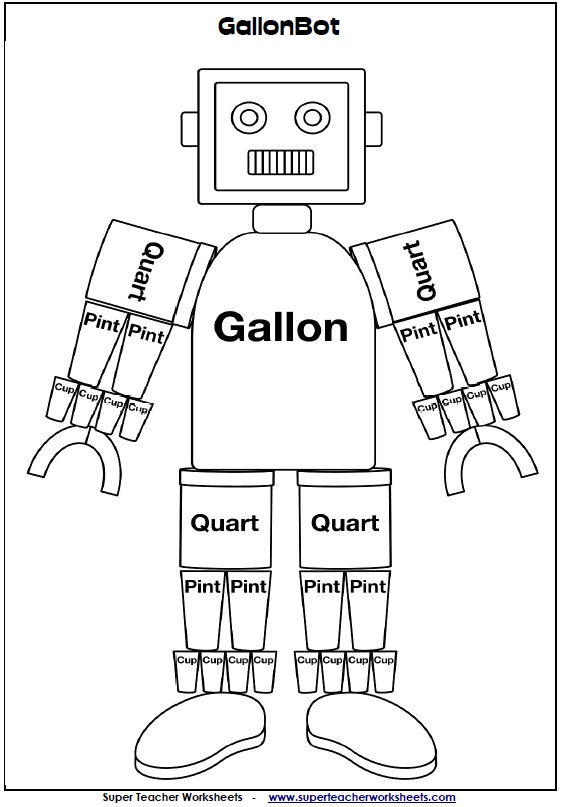
B. Gallon Bot
http://www.superteacherworksheets.com/images/gallon-bot.jpg
MA 6.2.5.d Determine the perimeter of
polygons
MA 6.2.5.e Determine the area of
parallelograms and triangles
MA 6.2.5.f Determine the volume of
rectangular prisms
MA 6.3 Students will
communicate algebraic concepts using multiple representations to reason, solve
problems, and make connections within mathematics and across disciplines.
MA 6.3.1 Relationships:
Students will represent, analyze, and use relationships to make
generalizations.
MA 6.3.1.a Describe and create simple
algebraic expressions (e.g., one operation, one variable) from words and tables
MA 6.3.1.b Use a variable to describe a
situation with an equation (e.g., one-step, one variable)
MA 6.3.1.c Identify relationships as increasing,
decreasing, or constant
MA 6.3.2 Modeling in
Context: Students will create, use, and interpret models of quantitative
relationships.
MA
6.3.2.a Model contextualized problems using various representations (e.g.,
graphs, tables)
MA 6.3.2.b Represent a variety of
quantitative relationships using symbols and words
MA 6.3.3 Procedures: Students will apply
properties to solve equations.
MA 6.3.3.a Explain the multiplication
property of equality (e.g., if a = b, then ac = bc)
MA 6.3.3.b Evaluate numerical expressions
containing multiple operations with respect to order of operations (e.g., 2 + 4
x 5)
MA 6.3.3.c Evaluate simple algebraic
expressions involving multiplication and division
MA 6.3.3.d Solve one-step equations involving
positive rational numbers
MA 6.3.3.e Identify and explain the
properties of equality used in solving one-step equations (e.g., addition,
subtraction, division)
MA 6.4 Students will
communicate data analysis/probability concepts using multiple representations
to reason, solve problems, and make connections within mathematics and across
disciplines.
MA 6.4.1 Display and
Analysis: Students will organize, display, compare, and interpret data.
MA 6.4.1.a Represent data using stem and leaf
plots, histograms, and frequency charts
MA 6.4.1.b Compare and interpret data sets
and their graphical representations
MA 6.4.1.c Find the mean, median, mode, and
range for a set of data
MA 6.4.1.d Compare the mean, median, mode,
and range from two sets of data
MA 6.4.2 Predictions
and Inferences: Students will construct predictions based on data.
MA 6.4.2.a Make predictions based on data and
create questions to further investigate the quality of the predictions
MA 6.4.3 Probability:
Students will apply basic concepts of probability.
MA 6.4.3.a Describe the theoretical
probability of an event using a fraction, percentage, decimal, or ratio
A. Shake and Spillhttp://pinterest.com/pin/92605336060086520/
B. Free Throws
http://pinterest.com/pin/141159769543008049/
C. M & M Data Analysis and Probability
http://pinterest.com/pin/36380709461265018/
MA 6.4.3.b Compute theoretical probabilities
for independent events
MA 6.4.3.c Find experimental probability for
independent events

No comments:
Post a Comment